Whenever I’ve faced a challenge, I’ve simply pressed forward. I didn’t spend much time thinking about anything beyond getting from point A to point B. Everything in between usually seemed to fall into place.
It was as simple as following a formula.
Take a marathon, for example. I would sign up, follow a training program and then run from the starting line to the finish.
I could find a formula for almost any challenge—school, work or even projects around the house. When the steps were clearly laid out, I didn’t have to give them much thought.
Breast cancer was obviously different.
I faced multiple surgeries, treatments and a long recovery. The uncertainty caught me off guard. There was no definite beginning and end. There was no formula—only ranges, percentages and changing timelines.
This challenge was going to require thought.
A lot of thought.
Before my diagnosis, I had developed a daily yoga practice, mostly because the studio was nearby and my friends went there. It became an autopilot routine.
I wasn’t interested in the “fluffy” parts—breathing, meditation or being present. I completed my workout and moved on to the next item on my to-do list.
I’ve written about how time stood still when I received my diagnosis. I resigned from my job and watched the clock tick while I waited two months for surgery.
There was plenty of time to tick. Plenty of time to tock. And plenty of time for unsettling thoughts.
I decided to direct that time and mental energy toward preparing physically and emotionally for a nearly nine-hour surgery.
More yoga!
This time, I worked on the “fluffy” parts too.
Quieting my mind was not easy. I began one minute at a time.
It worked.
I credit yoga with helping prepare my body and mind for both surgery and recovery.
Naturally, because I apparently needed another challenge, I decided to earn my yoga teacher certification.
Om shanti, shanti ever since.
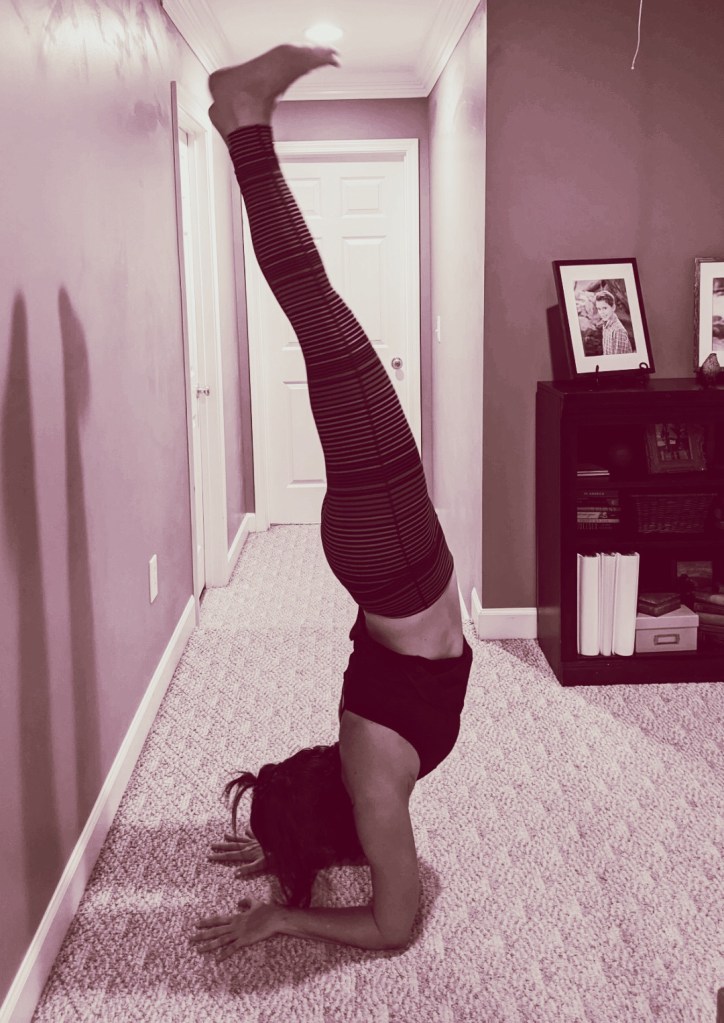
One pose had eluded me long before surgery: Pincha Mayurasana, or forearm stand. I had been working on it for two years.
The pose is often associated with courage, concentration and the third-eye chakra.
Whatevs, right?
Keep an open mind!
Pincha Mayurasana requires strong shoulders, arms and abdominal muscles—the last of which I’ve always lacked. It takes tremendous effort to find the sweet spot, but once you find it, the pose suddenly requires very little effort.
Depending on the day, I can find that spot.
That is how I am discovering the connection between body, mind and yoga.