Really we are!
Yes, I was anxious. Yes, I got very little sleep.
But my first treatment wasn’t nearly as bad as my mind had imagined. I didn’t know what to expect, and I hadn’t found many firsthand accounts of the experience.
Overpacked?
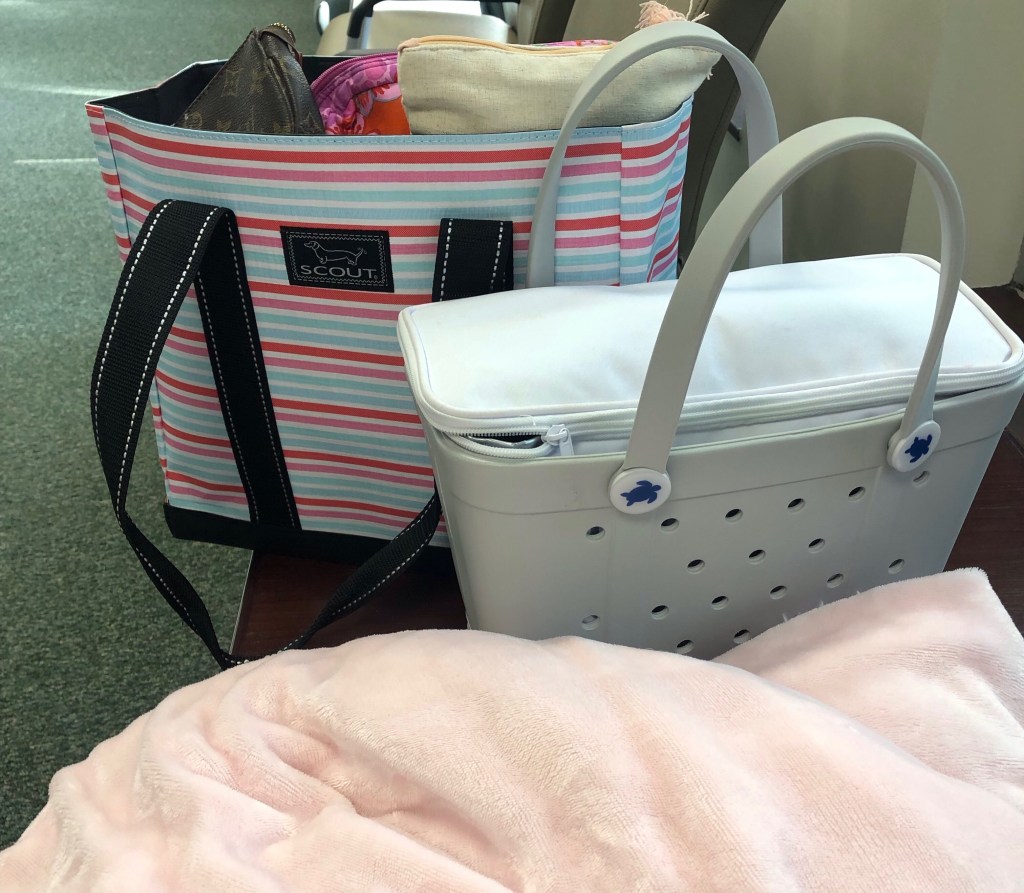
I prefer to say I was prepared for anything an infusion might bring: starvation, frigid temperatures, extreme heat, dehydration, boredom or dry skin.
I fixed my hair, added a little glam and wore something cute but comfortable.
Why not?
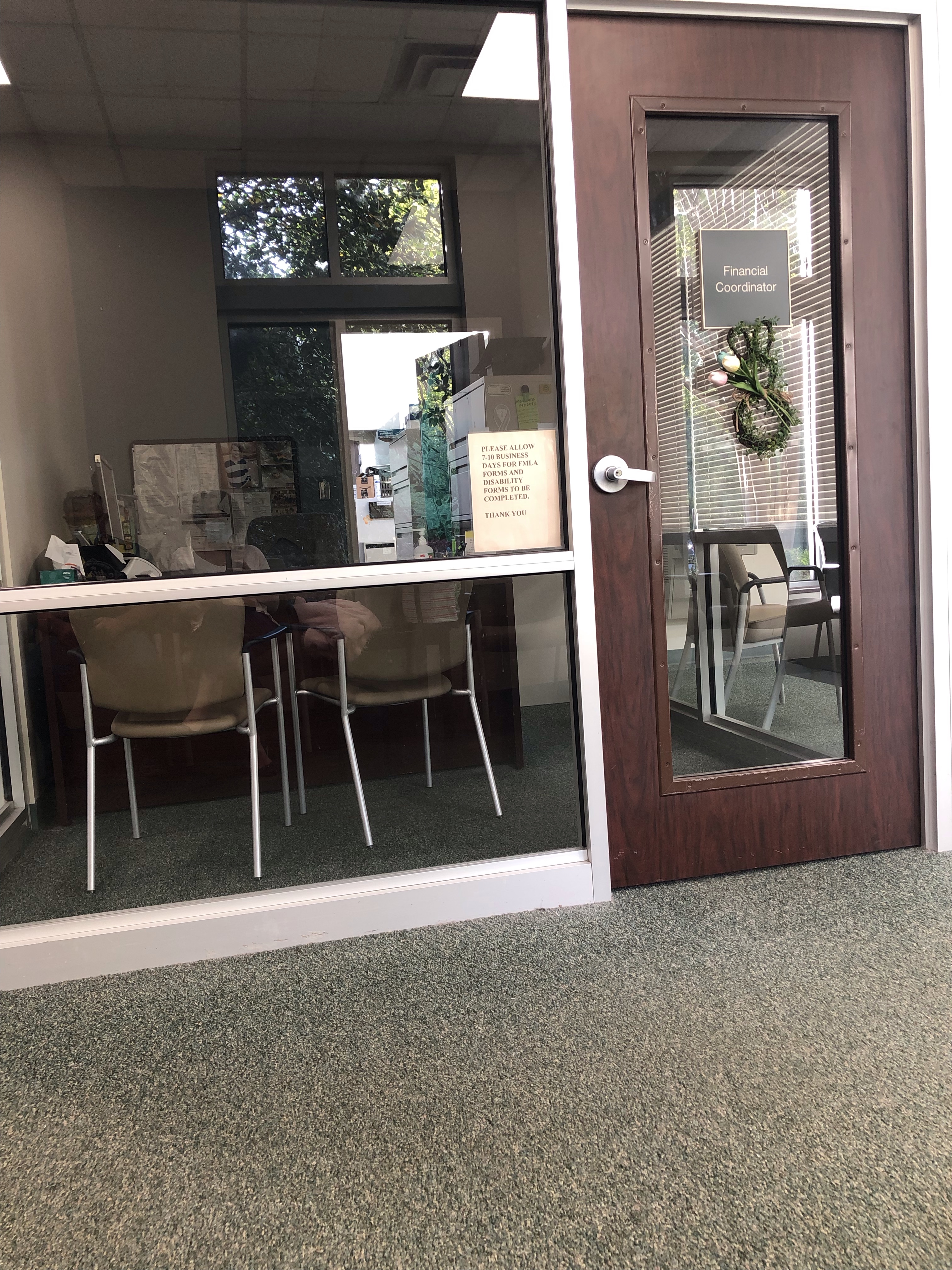
We arrived at the cancer center at 7:45 a.m. and were immediately hit with an insurance and billing problem. It was unsettling at first, but the issue was resolved.
Then, just like that, the director waved us through as though we had paid admission for a roller-coaster ride.
We followed tight twists and turns through doors, flashing lights and a hallway leading to a door marked “Infusion Room.” Our imaginary coaster slowed almost to a stop. It hung there, and my heart skipped before the big drop.
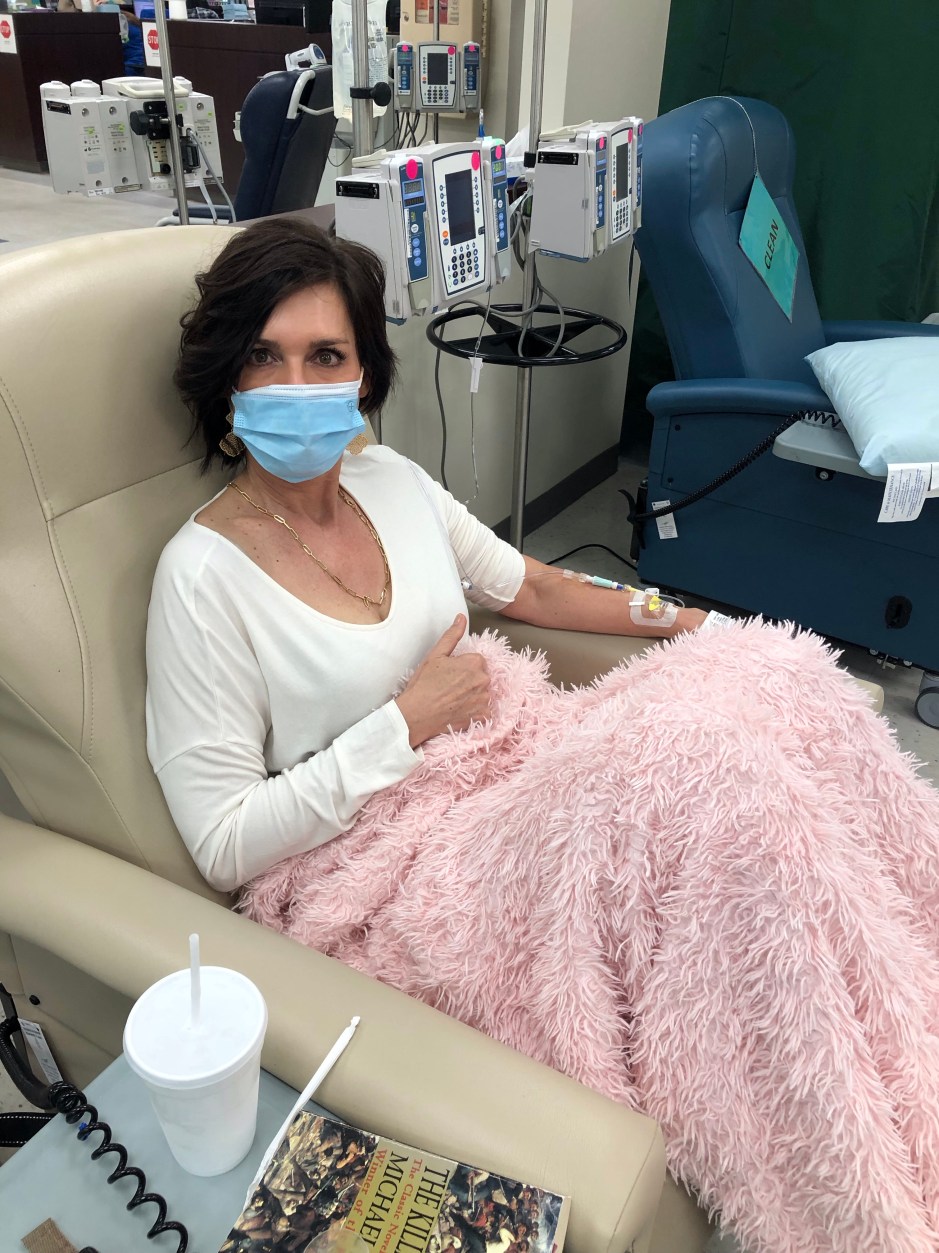
The door opened into a large room filled with more than 30 vinyl recliners.
We waited for the financial counselor to arrive.
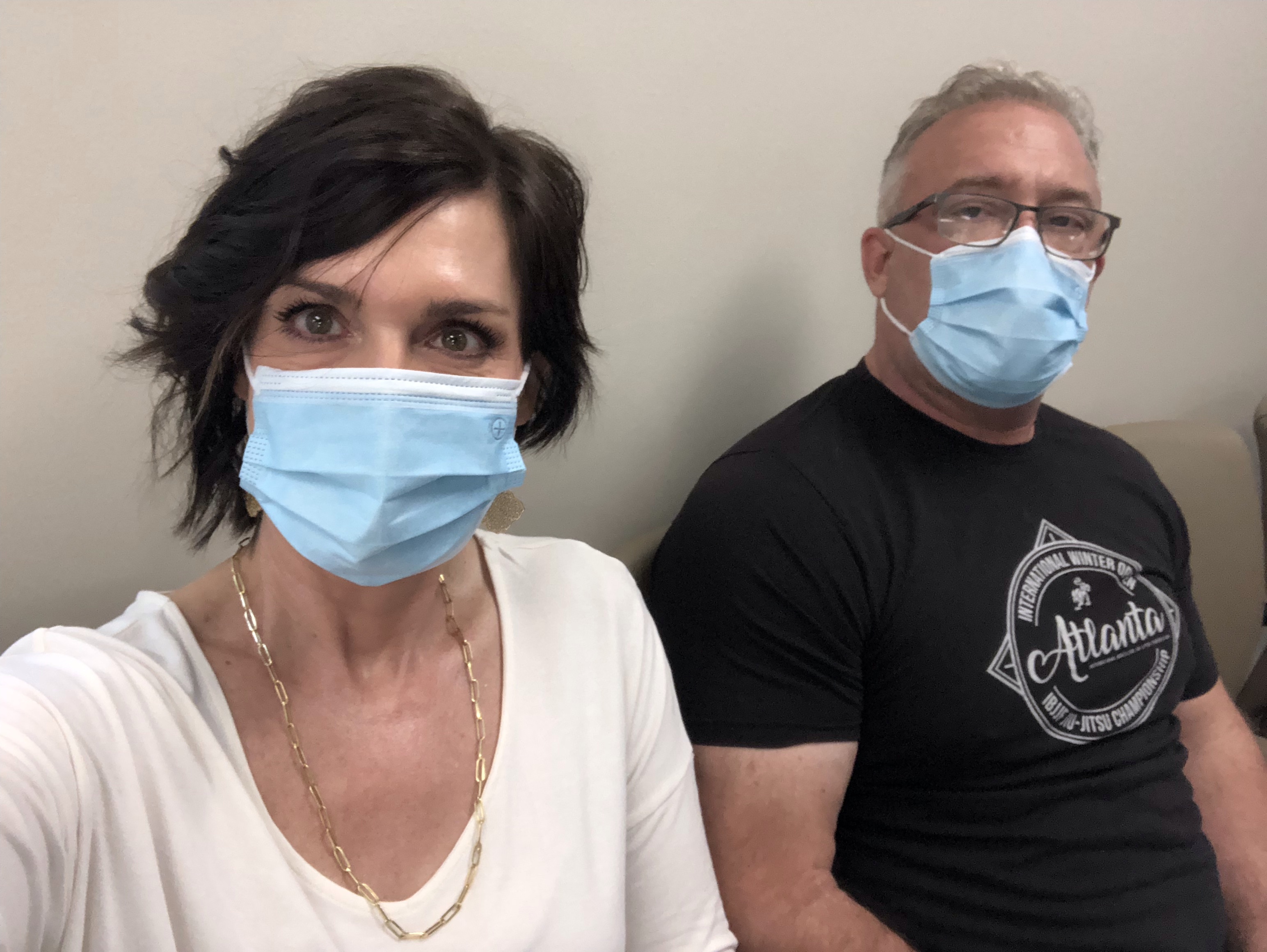
Trust us—we’re smiling!
Really, we are.
I met my nurse, Katie. I consider myself qualified to judge a good nurse by her needle work, and she was excellent.
She explained the infusion process and warned us that it would be a long day. We expected to be there for five and a half to eight and a half hours.
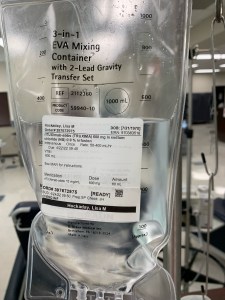
Before starting the rituximab, I received medications through my IV to help reduce the risk of an infusion reaction. I felt loopy and drugged, but I was ready.
The rituximab began with a very slow drip so my body could adjust. Nurse Katie checked my vital signs every 30 minutes—all day long.
Bobby left to get Starbucks, and my warrior sister in pink, Sarah, sat with me. She had an appointment of her own at the cancer center and knows this place all too well.
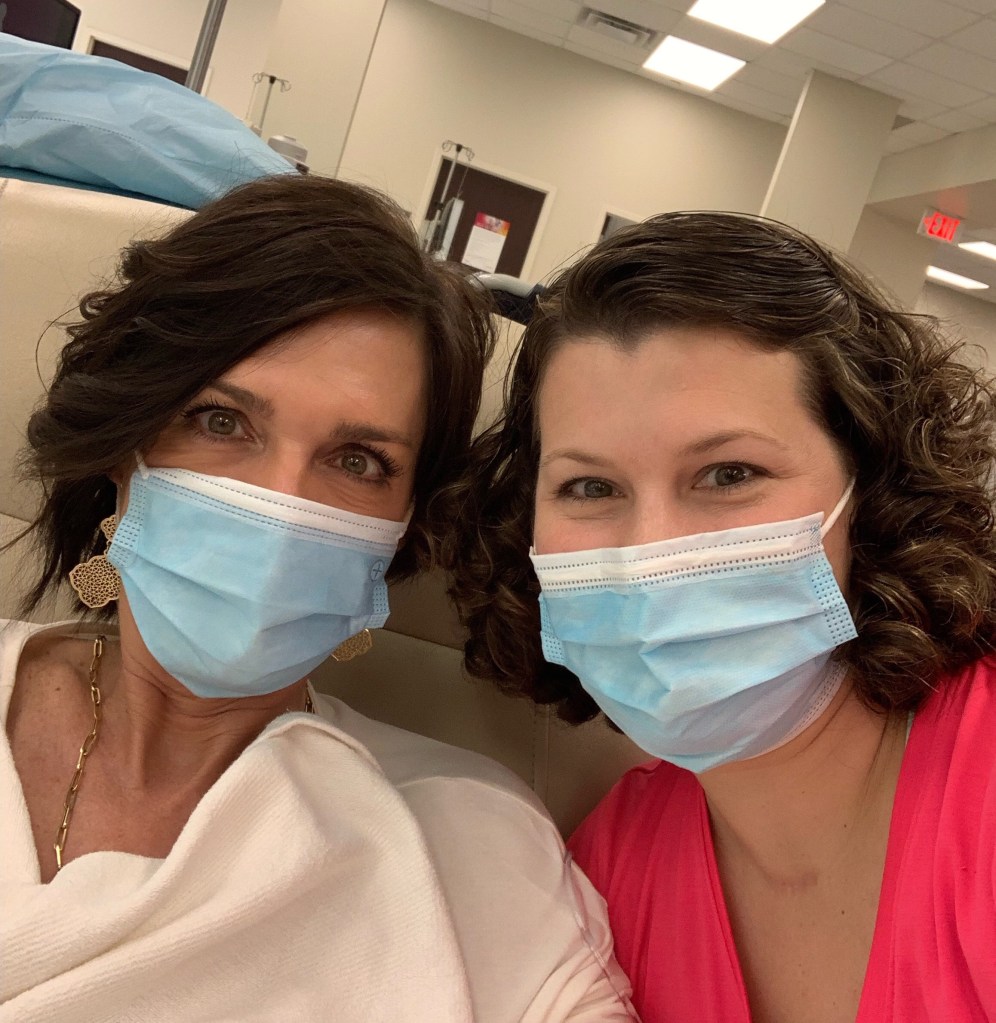
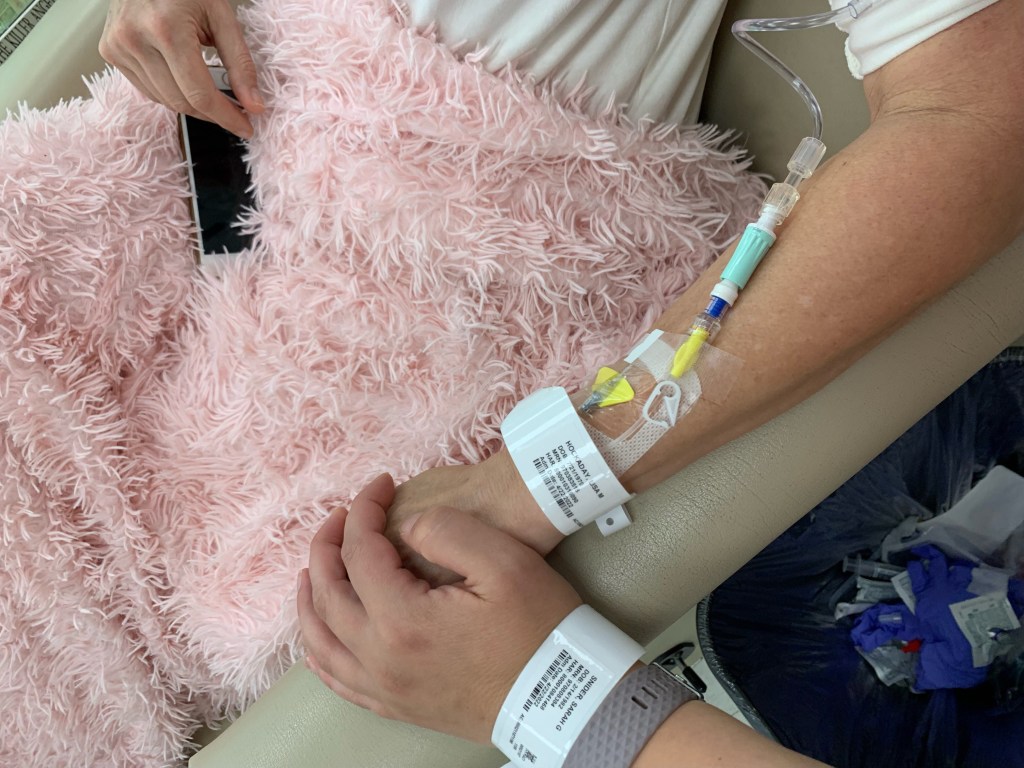
Her visit meant so much. Sarah received treatment during the pandemic, when visitors weren’t permitted. She is one of the strongest warriors I know.
She held my hand and tucked warm blankets around me.
About 45 minutes into the infusion, my throat began to itch. I could feel welts forming inside my mouth, and swallowing became difficult. Then my ears started itching, and my sinuses began to swell.
When Nurse Katie checked on me, I told her what was happening. She immediately stopped the infusion and checked my vital signs.
I was experiencing a serious infusion reaction.
She gave me another antihistamine, but the symptoms didn’t improve. I was terrified that my body might not tolerate the medication, but she reassured me that infusion reactions can happen and that the team knew how to respond.
The infusion remained paused for more than an hour. My doctor prescribed a steroid, and the reaction began to subside.
When treatment resumed, the drip was even slower.
And time began to tick.
I wasn’t in pain, but I was restless. I tried reading, working on a word puzzle and even folding origami, but the steroid made it difficult to concentrate.
Bobby returned and dozed.
I didn’t.
I watched the clock as patients came and went throughout the day. They smiled and then returned to their everyday lives, as though treatment were simply another item on a to-do list.
I may not know those people, but I can tell you this: They are amazing.
The remainder of the infusion continued without another problem. Nurse Katie kept checking on me and knew almost to the minute when we would finish.
She explained that next week they would begin with additional premedications and start the rituximab slowly. If my body tolerated it, they could gradually increase the rate. The second treatment might not take as long.
We arrived home around 4:15 p.m. I was hungry, tired and a little achy—almost as though I had the flu.
On Saturday, I felt fatigued and emotional. I couldn’t quite explain it beyond wondering, “Did yesterday really happen?”
It is still difficult to believe that I am facing a second cancer diagnosis. I also have an appointment with my breast cancer oncologist on Wednesday.
Oh, and did I mention that I was tired?
My stomach was unsettled, but so far I had no nausea. That alone could have completely changed my day.
It is now Sunday, and as I write this update, I feel pretty darn good!
I’m teaching a relaxing yoga flow today, and I’m looking forward to getting back on my mat.
The Science
Treatment for non-Hodgkin lymphoma varies depending on the specific type and individual patient. Some treatment plans include a combination called R-CHOP.
For my follicular lymphoma, my doctor chose to begin with rituximab alone.
Rituximab is a monoclonal antibody that targets a protein called CD20 on B cells. This helps the immune system identify and destroy certain cancerous B cells.